Introduction
In 2020, Native American Rights Fund released Obstacles at Every Turn: Barriers to Participation Faced by Native American Voters, a report highlighting the lessons learned from nine public hearings and 120 witnesses about the hurdles and barriers facing Native voters in Indian Country. It detailed systemic hurdles to voting.
The new report Obstacles Persist: According to the Data builds on the lessons learned in Obstacles at Every Turn, and brings statistical evidence that demonstrates how systemic breakdowns and barriers continue to impact Native voters at every step of the election process.
How You Can Help
The dismantling of the Voting Rights Act has now removed the main tool voters have to challenge discriminatory practices. At the same time, policymakers continue efforts to restrict voting across the board. We need more people to understand how discriminatory practices disenfranchise Native voters and why we must enact protections and policies that uphold the democratic process and support people’s right to vote — especially the first peoples of this land.
Help us get this report to more people by:
- Sharing it to your and your organization’s social media channels.
- Sending the report to your local elected officials (the full report is available on our website and can be downloaded for easier distribution).
- Emailing your constituents via your email list or direct, personalized outreach.
- Posting about it to your blog, email newsletters, or website and drive people to read the report.
- Combatting disinformation or misinformation around voting access and procedures by using information from the report.
Key Links and Resources
| Report: View PDF Report Also available through: vote.narf.org | NARF Official Social Media Channels: YouTube Threads BlueSky Useful Hashtags #NativeVote #GOTV #NativeVote2026 |
Read the Reports
- View the full Obstacles Persist: According to the Data report
- View Executive Summary of Obstacles at Every Turn
- View the full Obstacles at Every Turn report
Standout Quotes
- “Voting is not a singular act, it’s a sequential process. It’s a chain of registration, voting, provisional votes, counting, and curing ballots.”
- “Decades of racism and systemic failures in Indian Country mean each of the steps involved in voting is precarious, and Native voters face barriers at every one.”
- “Full access to the ballot is not simply a matter of civic engagement for Native people. It’s a matter of sovereignty, self-determination, and equity.”
- “For Native Americans, the right to vote has been obstructed, delayed, and denied across two centuries of United States history.”
- “Closing that participation gap is not simply a technical problem. It’s a question of whether American democracy is willing to extend its guarantees to all its citizens, including the first peoples of this land.”
- “There are precincts in Indian Country without a single ballot box. That should be offensive to everyone. You can’t have a voting precinct without a place to vote.”
- “Remember — even as we celebrate America’s 250th birthday — Native people only got the theoretical right to vote 102 years ago, and the practical right not until 1965 with passage of the Voting Rights Act.”
Key Messages
- Voter discrimination is rampant throughout Indian Country.
- With the continued gutting of the Voting Rights Act, Native communities continue to experience major barriers to voting — barriers that make it at times impossible. Now we have more evidence that proves it.
- The first people of the land should not be the last to vote.
- The continued dismantling of the Voting Rights Act is compounding those barriers by removing the most important tool for challenging them.
- Efforts to suppress Native people’s ability to vote don’t just make it hard, they can make it impossible.
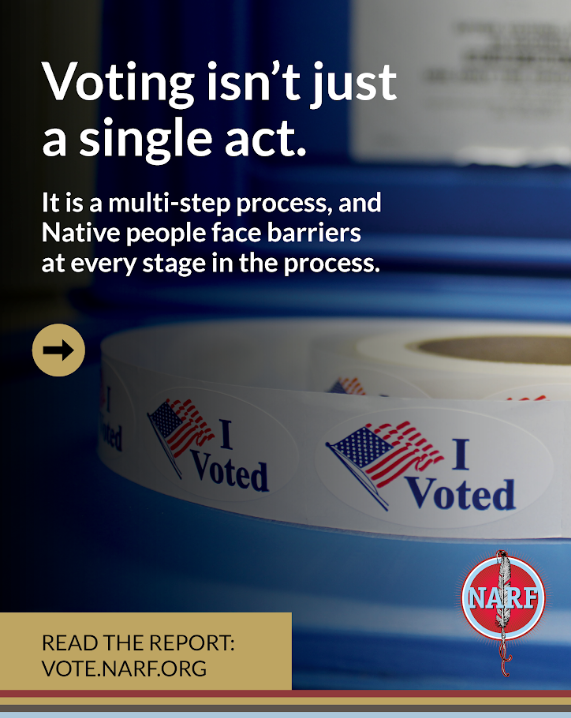
- Voting isn’t just a single act — it is a multi-step process, and Native people face barriers at every step of the process.
- Access to voting in Indian Country is not simply a matter of civic duty. It is a matter of sovereignty, self-determination, and equity.
- Obstacles Persist provides two dozen recommendations for ways to increase ballot access and successful voting for Native communities. We know what will improve voting in Indian Country; we must join together to call for action.
- We must remove voting barriers and challenges to participation by calling on Congress to pass the Native American Voting Rights Act (NAVRA).
- We are the First Americans. Count our vote.
Sample Social Media Content
- Voter discrimination is rampant throughout Indian Country. Native American Rights Fund recently released a new report demonstrating how Native voters continue to face significant roadblocks at every stage of the election process. Thankfully, there are things we can do today to protect our democracy and Native people’s access to voting. Read the report now: https://vote.narf.org/obstacles-at-every-turn/?utm_source=Social&utm_medium=Facebook&utm_campaign=PartnerToolkit&utm_id=ObstaclesII
- The first people on the land should not be the last to vote. And yet, a report newly released by the Native American Rights Fund shows persistent and systemic discrimination throughout the voting process at every step along the way. If you want concrete examples about how voter suppression impacts Native communities and how they can be addressed, read this report. https://vote.narf.org/obstacles-at-every-turn/?utm_source=Social&utm_medium=Facebook&utm_campaign=PartnerToolkit&utm_id=ObstaclesII.
- With the continued gutting of the #VotingRightsAct, Indian Country continues to experience major barriers to voting — barriers that can make voting nearly impossible.
And the @NativeAmericanRightsFund has the receipts to prove it. Read the newly released report: Obstacles Persist: According to the Data, on barriers that impact Native political participation. https://vote.narf.org/obstacles-at-every-turn/?utm_source=Social&utm_medium=IG&utm_campaign=PartnerToolkit&utm_id=ObstaclesII - Access to voting in Indian Country is not simply a matter of civic duty. It is a matter of sovereignty, self-determination, and equity.
A newly released report from @NativeAmericanRightsFund demonstrates how persistent barriers continue to disenfranchise Native voters at nearly every level of the election process. Learn how voting discrimination operates and what we can do to protect our democracy and the political process. https://vote.narf.org/obstacles-at-every-turn/?utm_source=Social&utm_medium=IG&utm_campaign=PartnerToolkit&utm_id=ObstaclesII
Threads
- Efforts to suppress Native people’s ability to vote don’t just make it hard, they can make it impossible. A newly released report from @NativeAmericanRightsFund demonstrates how barriers continue to stand in the way of Native people’s ability to participate in the political process. The first people on the land should not be the last to vote. Native people deserve better. https://vote.narf.org/obstacles-at-every-turn/?utm_source=Social&utm_medium=Threads&utm_campaign=PartnerToolkit&utm_id=ObstaclesII
- Native Americans continue to experience major barriers to voting. Barriers that can make voting at times impossible. And we have the evidence to prove it. Read the newly released report from @NativeAmericanRightsFund “Obstacles Persist: According to the Data”: https://vote.narf.org/obstacles-at-every-turn/?utm_source=Social&utm_medium=Threads&utm_campaign=PartnerToolkit&utm_id=ObstaclesII
- The first people on the land should not be the last to vote.
In a report released by Native American Rights Fund, we have new insights and analysis into how decades of racism and systemic failures have created barriers to political participation at every step of the electoral process. The barriers are not random. They are systemic.
The dismantling of the Voting Rights Act is only compounding those barriers by removing the most important tool for challenging them.
Read the report to understand the many ways Native communities are impacted, and what we can do to improve our political participation and uphold the values of the democratic process. https://vote.narf.org/obstacles-at-every-turn/?utm_source=Social&utm_medium=LinkedIn&utm_campaign=PartnerToolkit&utm_id=ObstaclesII
Access to voting in Indian Country is not simply a matter of civic duty. It is a matter of sovereignty, self-determination, and equity.
BlueSky
- The Voting Rights Act is being dismantled, and yet Native Americans continue to experience major barriers to voting. Barriers that can make voting often impossible. And there’s evidence to prove it. Read the newly released report from @NativeAmericanRightsFund “Obstacles Persist: According to the Data”: https://vote.narf.org/obstacles-at-every-turn/?utm_source=Social&utm_medium=BlueSky&utm_campaign=PartnerToolkit&utm_id=ObstaclesII
- Access to voting in Indian Country is not simply a matter of civic duty. It is a matter of sovereignty, self-determination, and equity.
A newly released report from @NativeAmericanRightsFund demonstrates how persistent barriers continue to disenfranchise Native voters at nearly every stage of the election process. https://vote.narf.org/obstacles-at-every-turn/?utm_source=Social&utm_medium=BlueSky&utm_campaign=PartnerToolkit&utm_id=ObstaclesII
Sample E-Newsletter Content
Option 1: Approx 165 characters
NEW REPORT: Native American Rights Fund releases new report showing how Native voters continue to face significant roadblocks at every stage of the election process.
Option 2: Approx 400 characters
Native American Rights Fund released a new report demonstrating how Native voters continue to face significant roadblocks at every stage of the election process. The data revealed in the report illustrate a voting process that is starkly different than what most Americans experience, resulting in higher rejections of voter registrations and ballots cast, and more voters removed from statewide rolls.
Sample Long-Form Content – Ex: Blog Post, long-form email, Substack, etc.
New data: Native voters hit significant roadblocks at every stage of election process
Native Americans continue to experience significant, compounding barriers to voting at every step of the election process, from registration to ballot counting, according to a new report from the Native American Rights Fund (NARF). The report analyzes data collected by the U.S. Election Assistance Commission from 2020, ‘22, and ‘24.
The numbers illustrate a voting process that is starkly different than what most Americans experience, resulting in higher rejections of voter registrations and ballots cast, and more voters removed from statewide rolls. This comes amid a raft of political efforts this year to restrict voting across the board. At the same time, the systematic dismantling of the Voting Rights Act has effectively removed the main tool voters have to challenge discriminatory practices.
“Voting is not a singular act, it’s a sequential process,” said NARF Senior Staff Attorney Allison Neswood. “It’s a chain of registration, voting, provisional votes, counting and curing ballots.”
Among the findings in the new Obstacles Persist: According to the Data report:
- Rejections of voter registration applications by mail and at DMVs skyrocketed in areas with larger Native American populations, even as they fell nationally. Rejections rose by an average of 200% in counties where Native Americans are at least one-quarter of the population.
- The rejection rate of mail-in ballots rose in areas with larger Native populations, even as actual mail-in voting numbers declined. Between 2020 and ’24, rejections for missed deadlines increased 134% in counties where Native Americans make up more than 25% of the population, compared to a rise of 55% nationally, strong evidence that USPS network disruptions had a significant impact with Native voters.
- While the rate of provisional ballots successfully counted in areas with larger Native populations rose between 2020-2024, it was still 15 percent lower than the national counted rate.
The causes for disparities in successful Native voting are sometimes familiar (such as short deadlines for receiving mail-in ballots), but often specific to Indian Country — such as voters being removed from rolls in areas where there is unreliable mail service or poll workers not accepting Tribal identification.
“For Native Americans, the right to vote has been obstructed, delayed, and denied across two centuries of United States history,” said NARF Senior Staff Attorney Jacqueline De León. “Closing that participation gap is not simply a technical problem. It’s a question of whether American democracy is willing to extend its guarantees to all its citizens, including the first peoples of this land.”